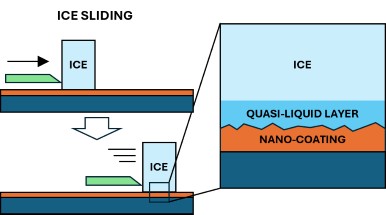
The presence of ice on surfaces such as aircrafts, wind turbines and solar panels, is a major challenge that results in safety issues and economic losses. Current solutions to this problem include the use of hydrophobic and superhydrophobic surfaces, often based on fluorinated substances, which however are raising concerns for both human health and environment. An alternative could be to exploit the formation of a layer of quasi-liquid water on the surface of hydrophilic materials to gain a reduction in ice adhesion strength.
In the article “Ice sliding on nanoscale-smooth surfaces and the role of the quasi-liquid layer” (DOI: 10.1039/D5MH02428E) published by Materials Horizons (Royal Society of Chemistry, Impact Factor 10.7 (Clarivate Analytics, 2024)), the authors explore a peculiar regime of ice sliding on nano-scale smooth surfaces attributed to the presence of a quasi-liquid layer (QLL) of water at the interface. QLL thickness on glass surface as a function of different parameters was first inferred. Then, glass surface was functionalized with a layer of polysaccharides to further increase QLL thickness and obtain a reduction in ice adhesion strength. The low ice adhesion strength gained in the case of hyaluronic acid, together with the non-toxicity and biodegradability of polysaccharides, makes it suitable to develop environmental-friendly coatings for low ice adhesion applications.
Federica Marelli, Luca Stendardo, Carlo Antonini and Irene Tagliaro of the Department of Materials Science, University of Milano-Bicocca carried out the work in collaboration with Matteo Pedroni and Espedito Vassallo from the Institute for Plasma Science and Technology (ISTP), National Research Council (CNR) of Milan, Aleksandra Cebrat and Samuele Tosatti from SuSoS AG of Dübendorf, Switzerland and Kevin Golovin from the Department of Mechanical & Industrial Engineering, University of Toronto.