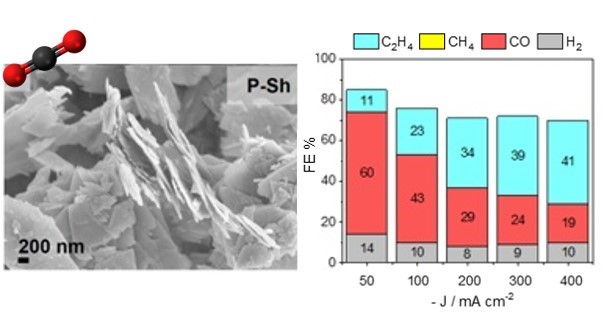
Converting carbon dioxide into valuable chemicals using electricity is one of the most promising strategies to reduce greenhouse gas emissions and promote a circular carbon economy. Among the materials investigated as electrocatalysts, copper plays a unique role, as it is the only metal capable of promoting the formation of products containing two or more carbon atoms (C2+), such as ethylene and ethanol, which are of great interest to the chemical industry.
The recent article “Effects of CuO-derived catalysts morphology on carbon dioxide electrochemical reduction in a flow cell” (doi: 10.1016/j.mtcata.2026.100147), published in the journal Materials Today Catalysis (Impact Factor 10.1; 2025 Journal Impact Factor, Journal Citation Reports, Clarivate Analytics, 2026), demonstrates that catalytic performance is determined not only by the chemical composition of the catalyst, but also by the morphology of the particles from which it is composed.
In the study, three copper oxide (CuO)-based catalysts with different morphologies (sheet-like, spheroidal, and tabular-prismatic) were synthesized and investigated. The results showed that the catalyst composed of sheet-like particles was significantly more efficient in producing C2 compounds than the other materials, achieving an overall selectivity of approximately 50% toward C2 products, with an ethylene Faradaic efficiency exceeding 40% even at high current densities. Another important finding concerns catalyst stability. The sheet-like material retained its structure even after several hours of operation, maintaining high catalytic performance, whereas the spheroidal and tabular-prismatic catalysts tended to undergo structural reorganization during the electrochemical process, progressively losing efficiency.
These findings demonstrate that tailoring catalyst morphology represents a key strategy for improving the electrochemical conversion of CO2 into two-carbon products, opening new perspectives for the development of sustainable technologies aimed at carbon dioxide valorization.
The study is the result of a collaboration between the Department of Materials Science at the University of Milano-Bicocca, the University of Turin, and the University of Milan. In particular, the research group led by Prof. Roberto Nisticò, comprising Falak Shafiq, Davide Melotto, and Dr. Tatiana Rodríguez-Flores, was responsible for the synthesis and characterization of the copper oxide catalysts with different morphologies, contributing to demonstrate the crucial role of structural design in the development of new materials for the electrochemical conversion of CO2.